Behind the Strip Mall: How I Find Fairytale Locations That Cost You Nothing
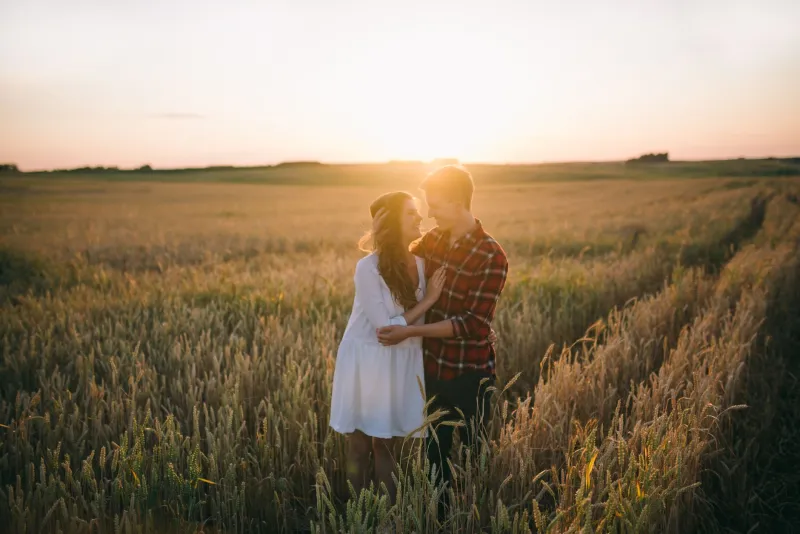
There's a field behind a shopping center about fifteen minutes from my house that has produced some of my favorite images ever. I'm serious. Between a Home Depot and a dentist's office, there's an unmarked gravel pull-off, and if you walk past the dumpsters about two hundred yards, you hit a rolling meadow that turns molten gold every evening around 7:30 in June.
My clients never believe me when I say, "Trust me, park next to the carts." Then they see their gallery and ask if we rented a private ranch.
We didn't. We never do. And today I'm pulling back the curtain on exactly how I find these places — because honestly, once you know what to look for, you'll start seeing magic in the most mundane corners of your town.
Pretty in Person vs. Pretty in Pictures
Here's the thing nobody tells you: a location that's gorgeous in real life often photographs terribly, and vice versa.
Think about a manicured botanical garden. Stunning when you're standing in it, right? But in a wide shot, you get parking lots, fences, power lines, and a dozen other visitors in the background. It's busy. It's literal. The camera records everything your brain politely edits out.
Now think about that weedy meadow behind the strip mall. In person? Kind of meh. But put a couple in it at golden hour, shoot with a wide aperture, and suddenly you've got layers of soft, glowing texture with zero distractions. The mess disappears into what photographers call bokeh — that dreamy, melted-butter blur behind your faces.
When I scout, I'm not looking for what a place looks like. I'm looking for what a place lets me do. Clean backgrounds. Interesting light. Depth — meaning something in the foreground, something behind you, and open space beyond that. That's it. That's the whole secret.
My Three Free Location Goldmines
The forgotten edges of public parks. Everyone photographs at the main entrance or the famous flower bed. I drive to the back. The overgrown trail nobody uses, the tree line where the mowing stops, the little wooden bridge that didn't make the brochure. Public land is free to use, and the overlooked corners are usually the most untouched.
Creek crossings and water edges. There's a shallow creek crossing twenty minutes from me where the water spreads flat over smooth rock. On a humid morning, mist hovers over it until about 9 a.m. I've shot engagements there, maternity sessions there, once a whole family reunion. Water adds reflection, softness, and a sound that makes people relax — more on that in a second.
Open fields with one interesting thing. One gnarled oak in the middle of a hayfield. One red barn collapsing gracefully in the distance. One lone wildflower patch. A single focal point in negative space is compositional gold, and farmland edges all over the country are full of them if you're willing to slow down and look.
What I'm Actually Checking For
When I scout a new spot — and yes, I do this on my own dime, on my own time, so session days run smooth — here's the mental checklist:
- Where does the sun set relative to the spot? I want backlight, meaning the sun behind you, wrapping everything in glow. A beautiful location facing the wrong direction is a beautiful headache.
- Is there shade nearby? Harsh midday light is the enemy. Open shade — like the north side of a grove of trees — is my best friend for families with little ones who can't wait for sunset.
- What's behind you when you shoot toward the good light? I'll literally stand where you'd stand and look at the background first. Trees, not telephone poles. Hills, not highway.
- How's the walk? If you're in wedding attire or wrangling toddlers, a half-mile hike is a dealbreaker. The best spots are close to parking, even if they don't look like it.
- Permits and rules. Most city and county parks in the US are free for personal sessions, but some require a photography permit. I always check so there are no surprises — and so you never pay a dime you didn't expect.
The Sound of a Location Matters Too
This one surprises people. A location that's quiet photographs better — not because of the audio, but because of your face.
When you're standing next to a creek, the white noise of the water makes conversation feel private. You stop performing. Your shoulders drop. You whisper without realizing it, and suddenly you're leaning into each other instead of posing next to each other. The same thing happens in a big open field — the wind, the birdsong, the sheer space — it all pulls you out of self-consciousness and into the moment.
That's the real magic I'm scouting for. Not a backdrop. A feeling.
You Can Scout Too
If you've got a spot you love — the trail you hiked on your first date, the lake from your childhood summers — tell me. I'd genuinely rather shoot somewhere meaningful to you than somewhere I've shot fifty times. And if it faces the wrong direction for light? I'll figure it out. I always do.
But if you tell me "somewhere dreamy" and hand me the reins? There's a good chance you'll end up parking next to a cart return, walking past a dumpster, and walking into the fairytale of the year.
Trust the gravel pull-off. It hasn't let me down yet.