The Candy-Free Playbook: 7 Games That Turn Toddler Chaos into Frame-Worthy Photos
Let me paint a picture you might recognize: it's five minutes into your family session. Your three-year-old has already said "no" to smiling, "no" to holding hands, and "no" to existing near the general vicinity of the camera. You're sweating. You're apologizing. You're reaching into your bag for the emergency fruit snacks.
Stop. Put the fruit snacks down. We're going to play a game instead.
After years of photographing families, I can tell you the kids who "won't cooperate" are almost never the problem. The problem is asking a four-year-old to do something that feels like a job. Kids don't perform on command — but they play on command, instantly and enthusiastically. So I stopped directing sessions and started running them like recess.
Here are the seven games that live in my back pocket, and why each one works.
1. The Reverse Psychology Sprint
I tell the kids: "Whatever you do, do NOT run to that big tree. Absolutely do not run to the tree. No running. None."
They run to the tree. Every time. Gloriously, gleefully, at top speed.
Why it works: Toddlers are in a developmental phase where autonomy is everything. Being told not to do something fun gives them the thrill of rebellion with zero actual stakes — and I get candid, full-tilt running shots with real laughter, not the tight "cheese" smile. Bonus: they burn energy early in the session, which makes everything after calmer.
2. The Whisper Game
When a little one clams up, I crouch down and whisper, so quietly they have to lean in to hear me: "Do you know what your mom's favorite food is? ...Pickles. Your mom loves pickles."
It's absurd. It's quiet. And suddenly a shy kid is whispering back, "Noooo, she likes... SPAGHETTI."
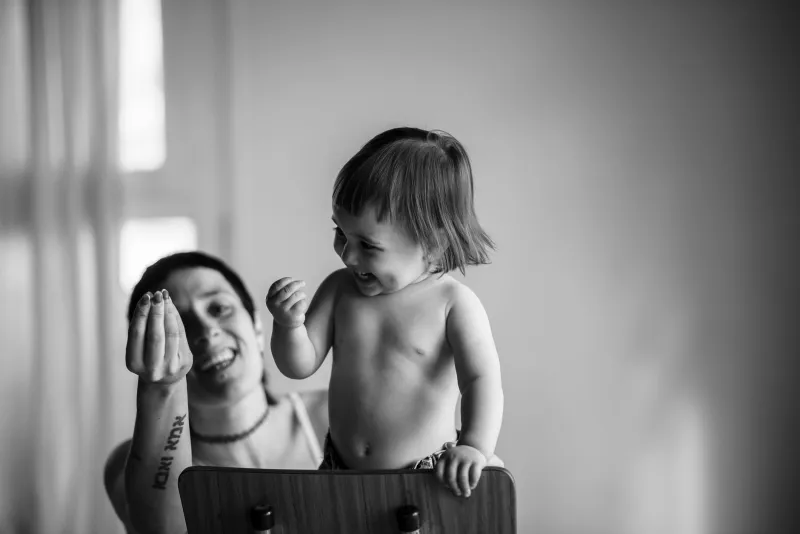
Why it works: A camera pointed at you is intimidating; a secret being shared is intimate. Whispering lowers the volume of the whole interaction, pulls the child physically closer to mom and dad (hello, natural snuggle poses), and gives them a moment of connection instead of performance.
3. Stinky Feet Countdown
I sit the family down, then sniff dramatically. "Wait. WAIT. Do your feet stink? I need to check. On three. One... two... two and a half..." — then everyone yanks off shoes and shoves feet toward the camera while I shriek and fall over.
Why it works: Silliness plus anticipation plus a physical action equals genuine, open-mouth laughter — the kind you can't fake. It also gets everyone sitting close together on the ground, which is one of my favorite relaxed family poses. Kids this age find bodily humor (feet, butts, toots) absolutely peak comedy, and honestly? They're right.
4. The Say-It-Wrong Game
Kids love correcting adults. So I confidently misname everything. "Look at this beautiful doggy" (it's a cat). "What a lovely yellow shirt" (it's green). "Is that your GRANDMA?" (it's their dad).
Why it works: Nothing engages a child faster than the chance to be the smart one. Correcting me gives them control and status in a situation where they usually have neither. And the smug little grin they give while fixing me? That's a gallery cover shot.
5. The Tickle Monster Is Coming... Eventually
I tell the kids the Tickle Monster is on his way, but he's slow. He's in the parking lot. Now he's at the gate. Now — "NOT YET!" — he's walking up the hill. Parents behind the kids, arms up, wiggling fingers, building the suspense until the moment he "arrives."
Why it works: Anticipation produces more laughter than the payoff. The long build means a solid thirty seconds of giggling, squirming, and grabbing onto parents for protection — which is really just an extended cuddle pose with built-in joy. Parents get to be the heroes, too, which shifts the whole family dynamic from "behaving for the camera" to "playing together."
6. Simon Says, Photographer Edition
"Simon Says touch your nose. Simon Says hop like a bunny. Simon Says... hug your sister! Simon Says squeeze her TIGHTER!"
Why it works: It's a game they already know, so there's zero learning curve, and I can sneak in every pose I need as a "command." Hug, hold hands, look at each other, stand on the rock — all disguised as play. The kids think they're running the show. (They are, technically. Just the show I scripted.)
7. The Pop Quiz
Toward the end, I get quiet and serious and say, "Okay, real quick, I need to ask you a very important question." Dead serious face. "What does a cow say?" Then a chicken. Then a dinosaur. Then I ask the parents to make the animal sounds and the kids lose their minds watching mom moo.
Why it works: The mock-seriousness is the joke, and even shy kids will answer animal questions — it's a question they know they can nail. Watching parents be silly flips the usual hierarchy, and the laughter is real because the situation is real. There's no pretending involved anywhere in this game, which is exactly why the photos don't look pretend.
What This Means for You as the Parent
Here's the biggest takeaway: you don't need to bribe, threaten, or apologize your way through a session. You don't need your kids to sit still. You need them to play, and I need you to play with them.
So at your next session, when I ask you to moo like a cow or smell your child's feet, lean in. The parents who commit to the bit are the ones whose galleries look like joy — because it actually was.