Chasing That Light: The Real Reason Your Photos Glow When We Shoot Before Sunset
If you've booked a session with me, you've probably gotten that email: "Let's meet at the beach at 6:15pm." And if you've ever looked at the actual sunset time and thought, wait, isn't that kind of early? — this one's for you.
There's a reason I guard that pre-sunset window like it's the last slice of pie at Thanksgiving. Golden hour isn't just a pretty buzzword photographers throw around. It's the difference between photos that look like you on your best day and photos that look like a DMV portrait with better scenery.
What's Actually Happening at Golden Hour
Quick science lesson, I promise it'll be painless. When the sun sits low on the horizon, its light has to travel through more of our atmosphere to reach you. That extra distance scatters the blue wavelengths and lets the warm ones — golds, peaches, soft pinks — flood through. The result is light that wraps around skin like a filter you can't buy in an app.
Midday sun? That's the opposite story. It comes straight down, creating harsh shadows under eyes and chins, and it makes everyone squint. I've shot enough noon weddings to know: nobody loves their squinting photos.
At golden hour, the light is:
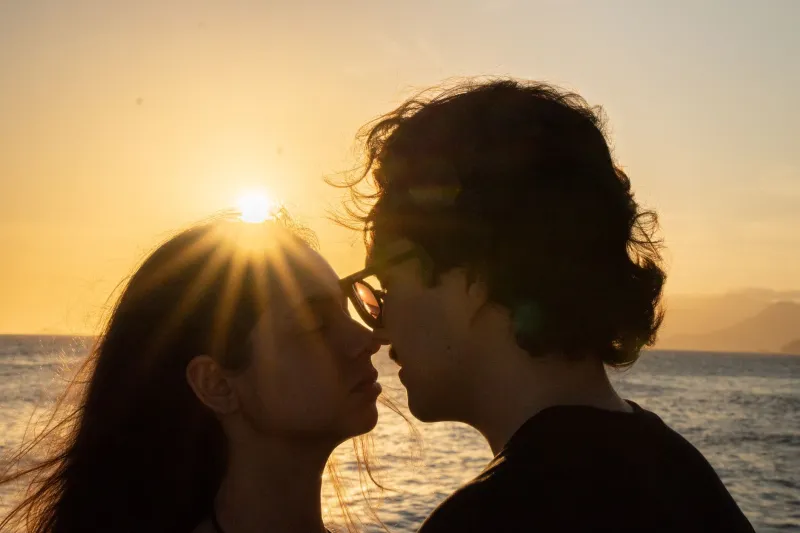
- Directional but soft — I can position you so the sun backlights your hair and creates that dreamy halo glow
- Warm-toned — skin looks healthy and luminous, not washed out
- Low contrast — no raccoon eyes, no blown-out foreheads
The 45-Minute Rule (And Why It's Not Arbitrary)
Here's my playbook: I schedule your session to start about 45 minutes before official sunset. That gives us time to warm up, shake off the awkward "someone is watching us pose" energy, and hit our stride right as the light turns to honey.
The best 20 minutes of the entire day? Honestly, the 15 minutes after the sun dips below the horizon. Photographers call it the "second golden hour." The sky turns pastel, the light goes soft and even from every direction, and it's when I get shots like the one of Marcus and Elena at Cannon Beach last fall — silhouetted against a lavender sky, completely unaware of my camera, just laughing at something only they heard.
Timing Across the Seasons (and Regions)
Golden hour isn't a fixed time — it moves, and it behaves differently depending on where you live in the US.
Summer: Expect late sessions. In the Pacific Northwest or the Northeast, sunset can land after 8:30pm in June. In Southern California or Florida, we're looking at 8pm-ish. Plan dinner reservations for after, not before.
Fall: My personal favorite. Sunset lands a friendlier 6-7pm in most of the country, the light is naturally amber even before golden hour kicks in, and sweater textures photograph beautifully.
Winter: Short sessions, big payoff. Sunset can be as early as 4:30pm in the Midwest, which means a 3:45pm start. Bonus: the low winter sun stays golden practically all afternoon.
Spring: Variable and gorgeous. Watch out for late-afternoon storms in the South, though — we always build a rain plan.
If you're somewhere mountainous — Colorado, Utah, Montana — know that mountains cause local sunset to happen earlier than the posted time. I always build in a buffer.
Side-by-Side: The Proof Is in the Photos
I did an experiment with the Henderson family last spring. We shot their first 20 minutes in open sun at their park, then moved to a shaded spot as the light dropped. The midday frames? Cute kids, sure — but hard shadows on faces, everyone squinting, colors flat. The golden hour frames from the same park? Backlit dandelion fluff floating in the air, warm skin tones, the works. Mom cried at the gallery reveal. She ordered the golden hour shot as a 30x40 canvas.
Practical Tips for Your Session
- Trust the schedule, even if it feels late (or early). I've done the math for your location and date.
- Eat a snack beforehand. A hungry family at 7:45pm is a hungry family in every photo.
- Golden hour sessions run shorter. 45-60 minutes is plenty — the light does the heavy lifting.
- Embrace the haze. That soft atmospheric glow you see in my portfolio? It's real light, and it only exists in that window.
The sunset will happen with or without us. The only question is whether you'll be standing in it when it does.